
Traditional Bulgarian technology for the production of rose oil
Gallery
Video conversation
coming soon
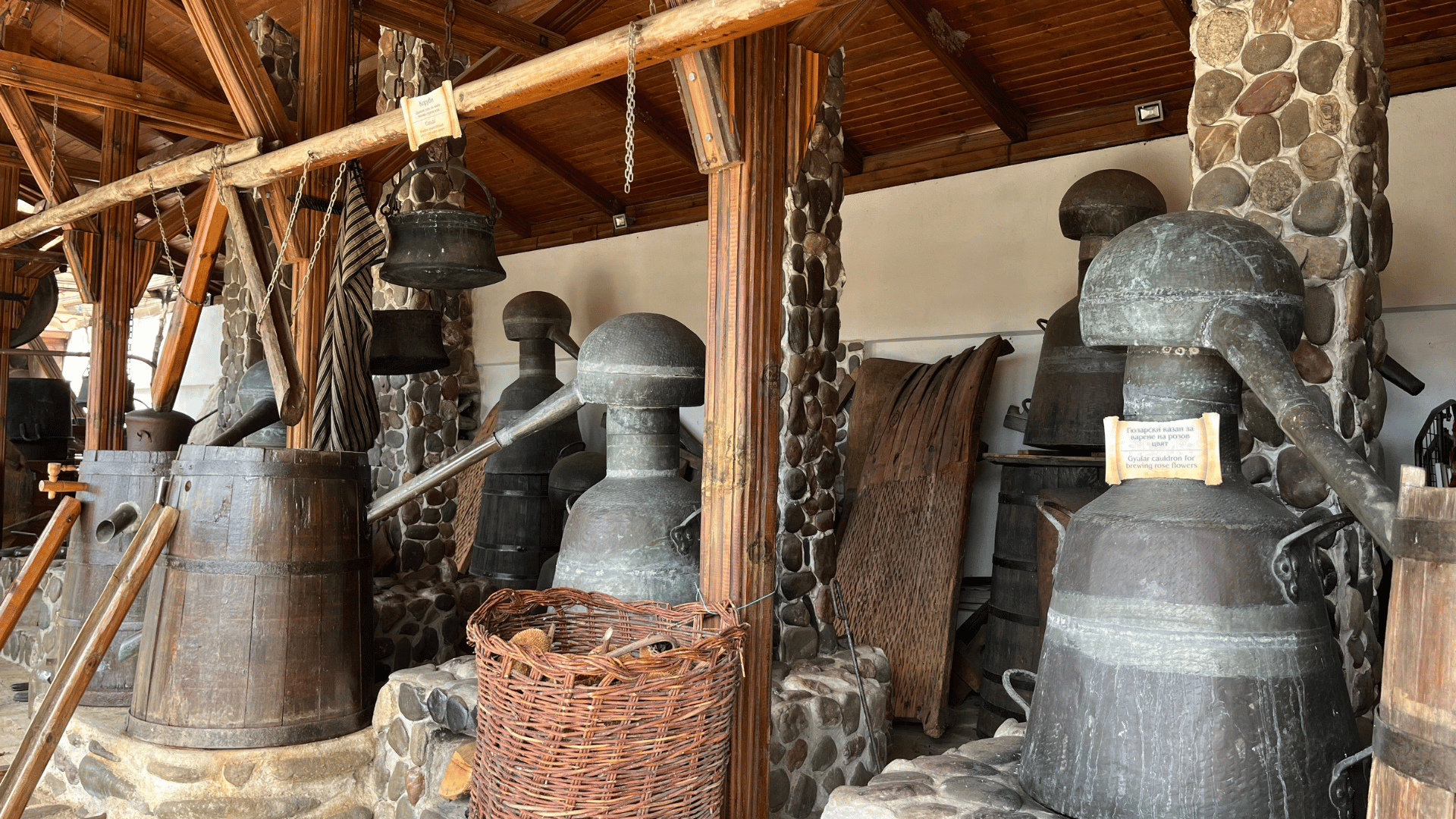
An old distillery: An old distillery is on display in the complex, „the gulapana”, which is made so, as gyulapans were made in the past (ago more than 350 year).
For initial year, during which the distillation of rose oil begins in our country, is indicated 1680, when the distillation method was transferred from the lands of today's Turkey to the Bulgarian lands. Using his expertise in making brandy, Bulgarian rose growers invented and introduced a number of improvements in the rose oil production process, such as double distillation. Through them, they not only increase the amount of rose oil obtained, but also improve its subtle aroma and unique qualities.
The Primitive Rose Garden "the gulapana” (from tour. word "gyulpane" - pink house), was built near running water, usually by the village river or fountain.
Gyulapskiy cauldron consists of two parts - a "cauldron" body and a lid, called "lula" in Kazanlak. The cauldron is made under the shape of a truncated cone with a long neck, into which the cover is woven and 4 handles - by 2 from both sides (so that it can be moved or carried more easily). The lid is in the shape of a pipe, whose handle is angled 450. the handle, which plays the role of a cooling pipe.
The Gyulap cauldron is placed on an open hearth of stones and placed next to each other, so much, as much as each owner owns. The collected ball is poured into the cauldron with the help of a large funnel (around 15-20 kg) and 4 times more water. It is important for the good quality of the oil the water is clean, not stagnant, so as not to transmit any odor to the oil. Most often, clean water is used, which also serves for drinking. The lid is placed on top and the throat is plastered with clay so that it does not "exhale".
In order to obtain quality oil, it is necessary to have money well chilled. For this purpose, cooling tanks placed next to each gulapana are used, named Gyulapski Kazi, which have the shape of an inverted truncated cone. The tube of the gyulapana pipe enters the upper end of the landing and exits at the lower part of approx 15 cm from the bottom. The cabins are continuously supplied with cold water by means of "Build it”(wooden chutes) to achieve maximum cooling.
After about an hour of starting the fire, it starts the distillation process, which lasts around 2-3 o'clock after the court closed. Extraction of better and higher quality rose oil depends on both the quality of the rose color, as well as from the master bow of the "brewer". It has been proven through practice, that the Bulgarians are the best masters in brewing rose oil.
The flowing rose water in a thin stream (rose distillate) is collected in special "gulap bottles”, where after standing on the surface the rose oil floats. The first ones 3 the bottles are allowed to stand, and the rest are returned to the cauldron for boiling. The oil, which floats is collected with "scoop” (a small tin funnel, which ends with a small hole, and a long one is welded to the upper end 20-25 cm handle). The separated oil is scraped off with the cap, and the rose water flows out through the hole. The oil is collected in oil bottles, called in the Kazanlak area "bullet bottles".
In later years, glass pipettes were used instead of "caps"., at the end of which a rubber balloon is inserted - they are used to better separate the oil from the water. And instead of "Gulap bottles" the use of "Ibritsi" - a copper vessel - entered, which have a tube in the shape of the letter "S" soldered to the bottom and reach the middle of the neck. On the principle of the jumped vessels, the rose water flows into another vessel, the rose oil, like lighter, separates at the top of the neck. Both – The "cap" and "beaker" were invented by the Bulgarian rose producer.
The rest of the "boiled gül" in the cauldron - the "broth"- it is squeezed in special sieves. The drained water is not thrown away, and it is returned to the cauldron for the next brewing, as it contains minimal amounts of rose oil and is heated (dilute with cold water to approx 600 and the next amount of pink color is poured with it). The squeezed, boiled rose flower “jibris” are used for animal feed or to fertilize the rose plantations.
To obtain one kg of rose oil, approx 3000 – 3500 kg pink color from a red Kazanlak rose. The yield depends both on the quality of the rose color, as well as the climate during the year. In dry and hot weather, it is weak, and in wet and rainy weather - good.
The amount of oil produced is measured by a special unit of weight, called muscle (of Arabic origin, in Bulgarian - "weight"), which is approx 5 grams.
A round copper vessel was used for commercial packaging of the oil, called "Konkum”. When selling the oil on foreign markets, the neck of the vessel is wrapped with a soft white cloth, it is encircled with a tricolor band and seals are placed with red wax. It's a sign, that the rose oil is Bulgarian. This packaging is still used today and as such is known in all international markets.
In the 90s of 19 V. Some of the major rosé traders-producers of rose oil, began to use gulapp cauldrons with capacity 500 liters, and later (1902Mr.) begin the use of cauldrons with capacity 800, 1000 and 2000 liters. The principle of distillation remains the same. Some changes are made such as the cooling vats are replaced with cooling towers in which the distillate passes through coils, the rose oil is collected in large "Florentine" vessels, which, like the "tubs", are based on the principle of the hopped vessels.
At the end of the campaign, rose water is made, which every rose grower leaves for "Ilach". It is used to apply it to itching, to treat diseased eyes, to drink with a sick stomach.
From 1906 Mr. the products increase, which are obtained from the oil-yielding Kazanlak rose. First, the production of pink concrete begins, and then on pink absolute, which are produced by extraction methods by the major rose producers.