
The construction of the Thracian Cultural Center on the territory of the Ethnographic Complex was conceived more than 15 years (2007) .
Construction activities began in the summer of 2017. and it took two years, for the building to be completed.
The facility was inspired by the great royal palace of Seutus III, which has been fully studied during the excavations of the city. Sevtopolis in 1948.
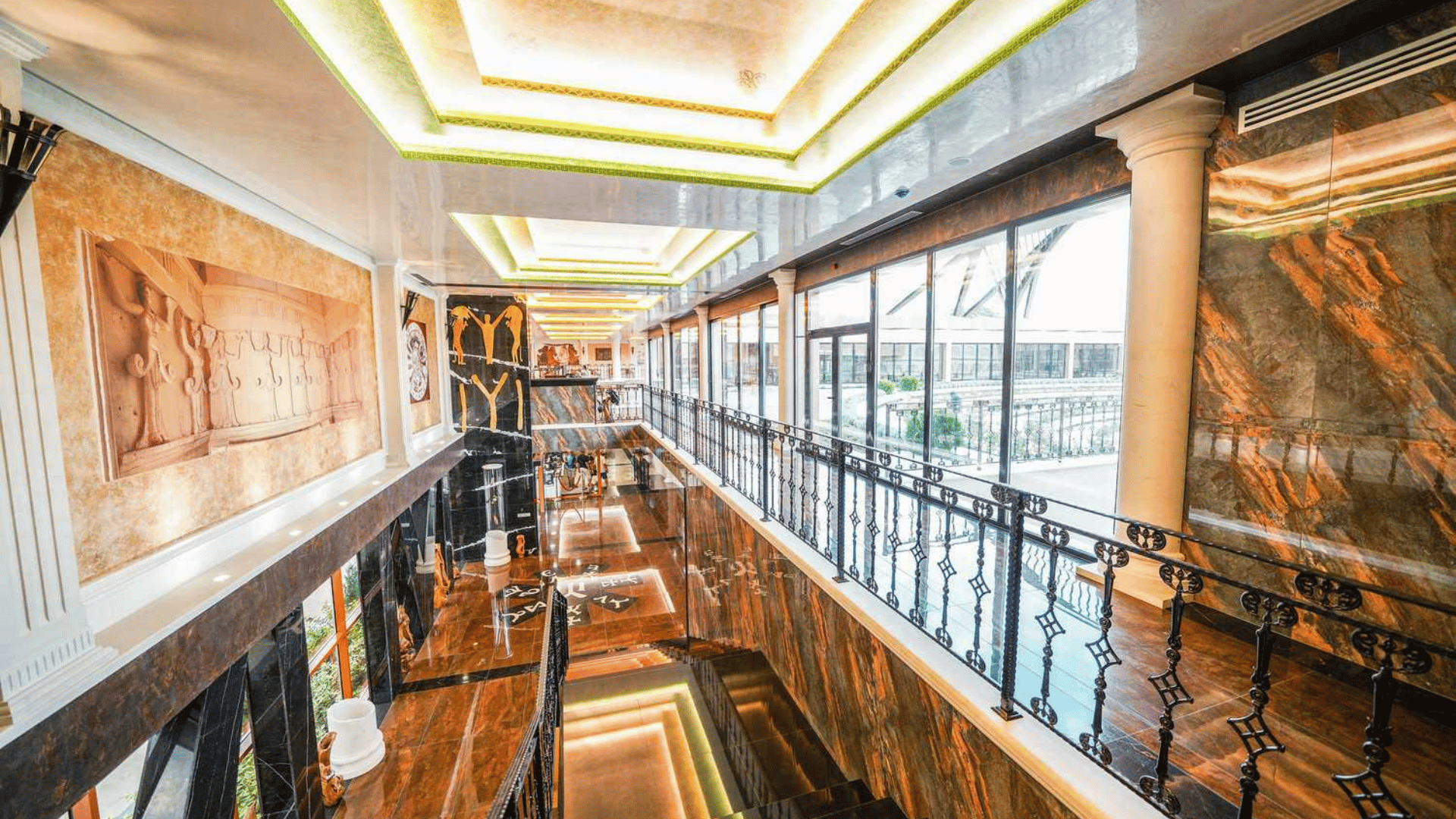
The Thracian cultural center is distinguished by its architecture. Seen from above, bird's eye view, the facility recreates the idea of a basket, full of fragrant roses. You can see it well from the second floor of the Thracian Cultural Center.
The interior, in turn, immerses you in antiquity. Through it we aim to remind you of greatness, unsurpassed craftsmanship, high culture, the traditions and philosophy of our ancestors.
The attraction has a purpose, on the one hand, to defend the theory of Bulgarian history from before 680 Mr. and on the other hand, to become the main scene of cultural life in the Valley of the Roses and the Thracian Kings.
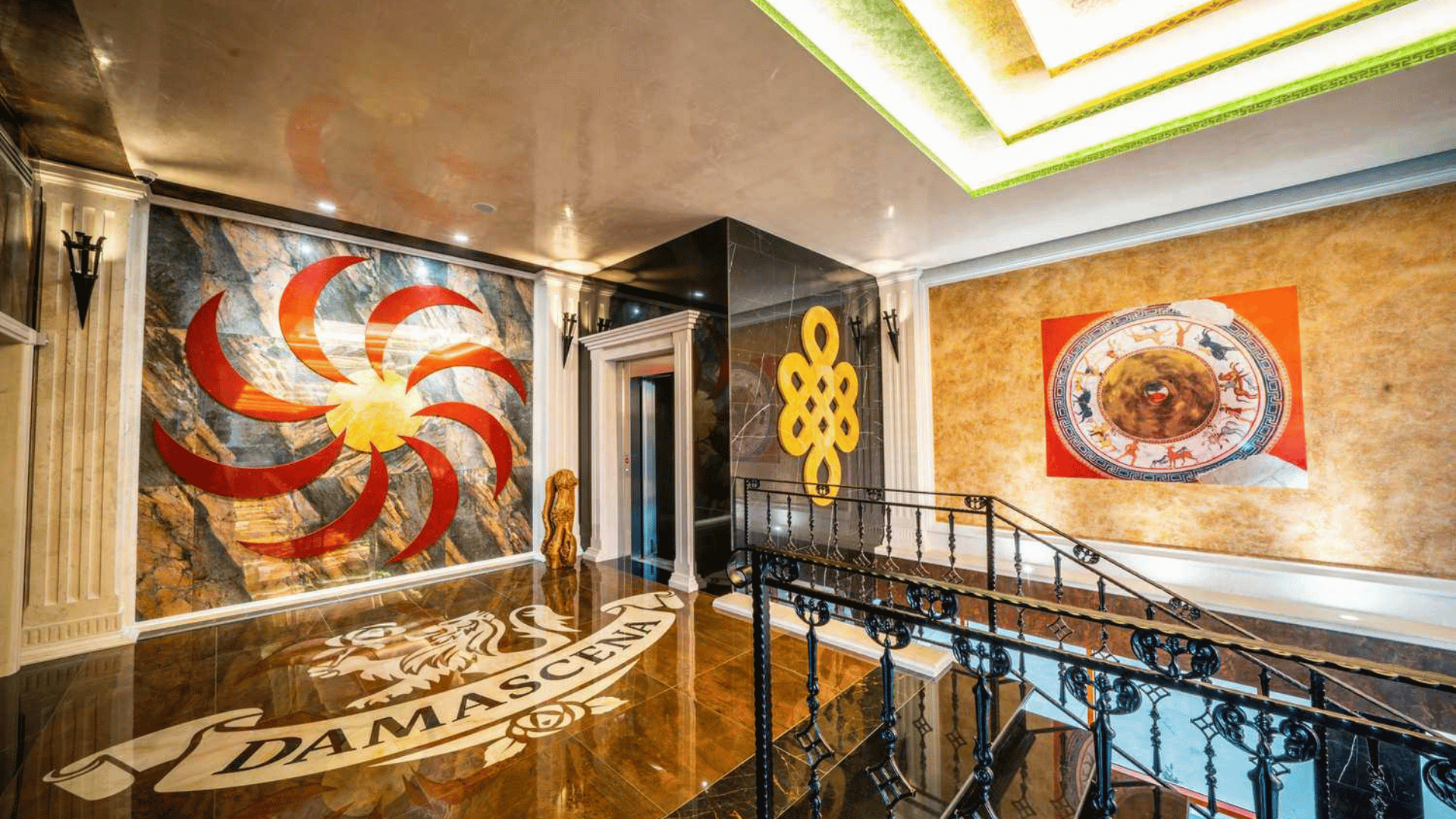
At the very entrance of the Thracian Cultural Center you will find the sacred symbol II , on the. Sun. Rosetta from Pliska. The rosette was discovered on the lands of the Varna civilization, recognized by scientists around the world as the oldest civilization in Europe – 4800Mr. etc. Hr. It does not belong to the late Bulgarian tribes, but it has much more ancient roots. To this day, the rosette has a special meaning for every Bulgarian.
The rosette is a runic system, consisting of 3 runes: (jesus), 
I (jesus) means full protection;
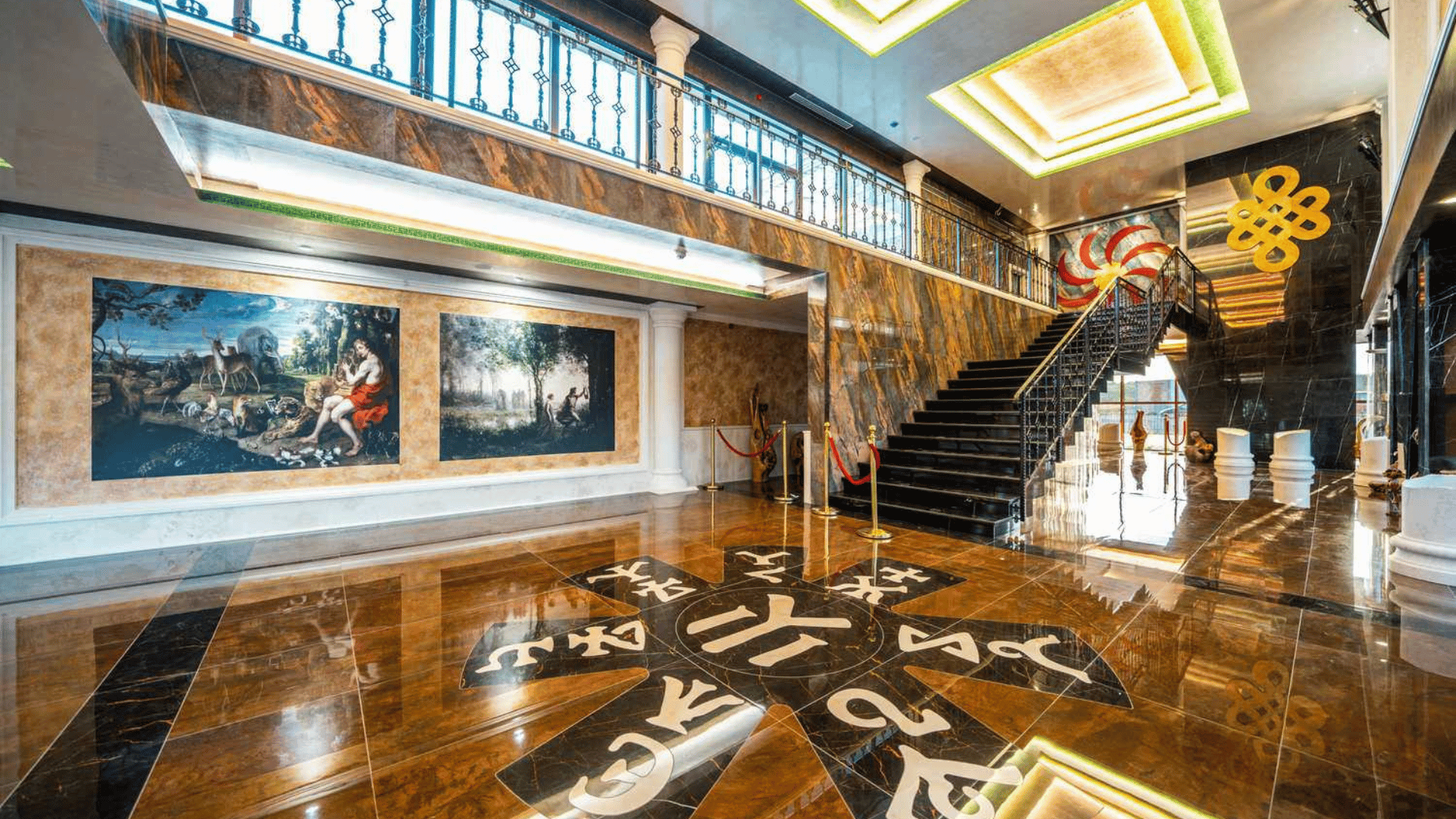
The runogram is also depicted on the wall in the central lobby of the Thracian Cultural Center.
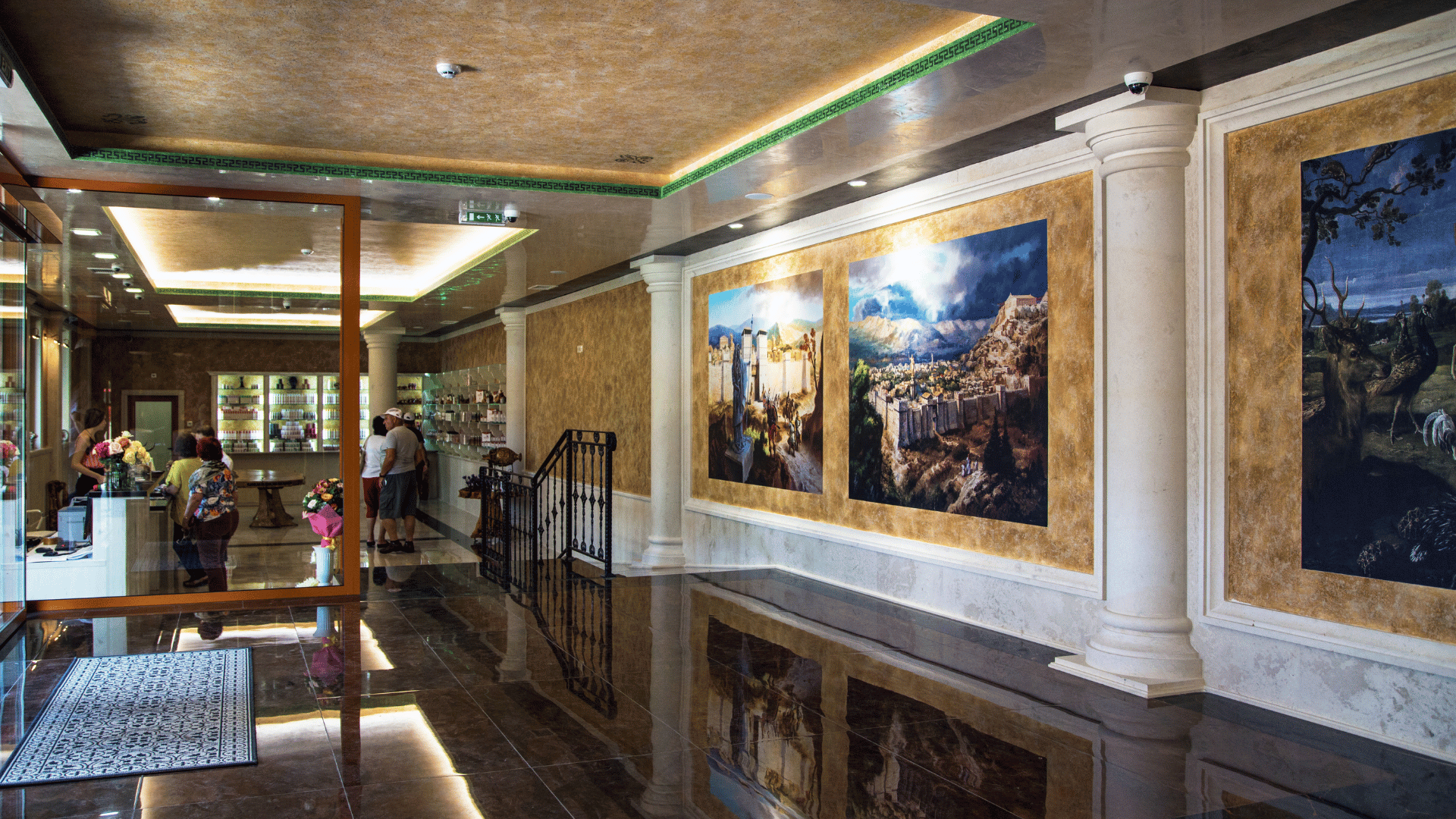
"City of Sevtopolis" and "City of Kabyle", author: Adrian Bekyarov
In the lobby you can also see artistic masterpieces, depicting the ancient Thracian cities of Seutopolis, which today is under the waters of the "Koprinka" dam and was the capital of the Odris kingdom, and Kabyle - the main center of the Odris kingdom and a city of particular importance for South-Eastern Thrace in the second half of the 1st millennium. etc. Hr. You can read more about the city of Sevtopolis in the section The statues of King Seutus III and his wife Queen Berenice.
"Orpheus Brings Eurydice Out of the Underworld", author: Jean-Baptiste Camille Corot (1861)
Placing Thracian culture at the center of our Thracian Cultural Centre, we cannot help but pay attention to a legendary person like Orpheus. He created the Orphic mysteries and sacraments in the early pre-Christian temple services, a singer, knowing the secrets of sound extraction and harmony with the Great Cosmic Rhythm. The Thracian epic tells of Orpheus, who only with the Voice and with the music subjugates the soul, and even inanimate nature, the visible and invisible forces.
The legend tells, that Orpheus descends into the underworld of Hades, to seek his Eurydice, as she is bitten by a snake and must die. This is actually where the idea of taking the soul from Hades was born. Eurydice is an allegory for his soul.
Orpheus must descend into this realm, to beg her release and bring her to the realm of the Sun - to Earth. Orpheus, with its charm, with his beautiful song, persuades Persephone and Hades to release Eurydice. But they put conditions on him. First, that they will be led by Hermes (the messenger of the gods). Hermes was to lead, let Orpheus go after him, and after them Eurydice. The second condition is that Orpheus does not turn back. A step before they go out into the realm of the Sun, on the ground, he hears a thud, something knocks behind him – doubt, the thought… Orpheus does not keep his promise because of doubt, due to uncertainty, even because of excessive affection.
The idea of doubt has been around for all time. Doubt is the most dangerous thing to faith. The idea of doubt! Do not turn back, when you want your Eurydice, put your thoughts away, remove your fear - know, that you will take her out!
The rich culture of our ancestors is also recreated through the unique frescoes and the various fragments of Thracian mounds, located on the territory of Bulgaria - Alexandrovska mound, Priest's mound, Kazanlak Mound and Ostrusha, near the city. Rosehip. This rich cultural heritage enables us to better understand the details of life, the customs, traditions and rituals, which the Thracians observed and fulfilled.
A central place for the Thracians is occupied by the cult of The sun, son of the mother goddess. It is a source of life, power and light. It combines in itself the divine and the mystical principle. Today we can find solar symbols woven into Bulgarian needlework.
One such symbol is the "Rosetta from Pliska", whose connection with the more ancient peoples of our lands remains to be proven.
The frescoes and symbols, which you will find on the walls of the Thracian Cultural Center, prove once again how ancient a nation we Bulgarians are and how history has been preserved over the centuries, to reach us and inspire us…
COPY OF THE PANAGYUR GOLDEN TREASURE AT "DAMASCENA"
In the lobby of the Thracian Cultural Center you will see a copy of the Panagyur Golden Treasure, discovered quite by accident in the distant past 1949 Mr. from three brothers near the town. Panagyurishte, that the treasure was owned by the Thracian king Seutus III, and its dating is from the end of the 4th century and the beginning of the 3rd century BC.
The treasure consists of nine gold items, the largest of which is an amphora-rhyton weighing approx 1,7 kg. Is considered, that the treasure was used for ancient Thracian rituals and customs.
The Panagyur gold treasure is an extremely beautiful gold service with very rich decoration and ornamentation – priceless, a highly artistic and unique witness to antiquity, of exceptional importance for the study of the Thracians and their way of life.