
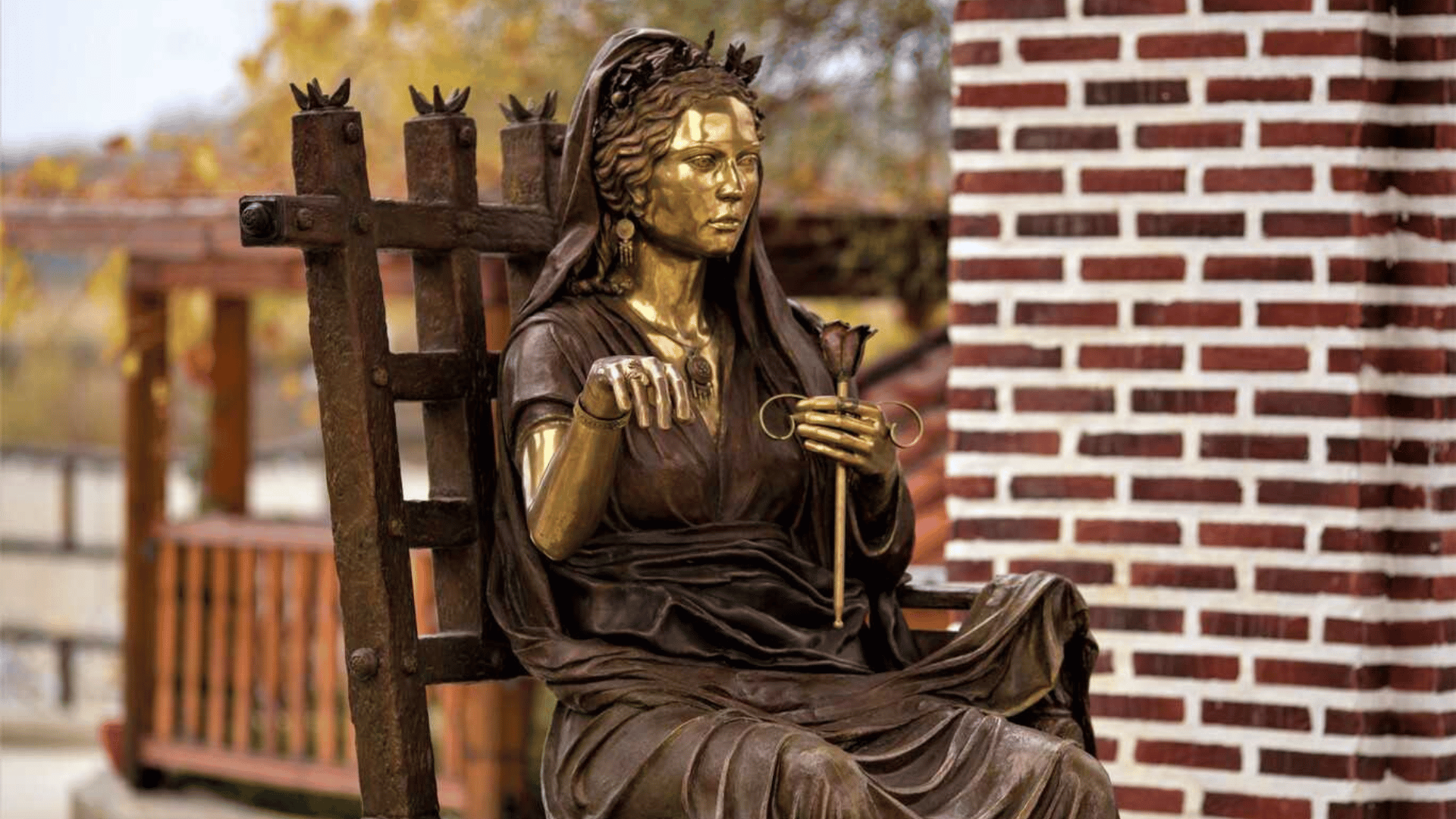
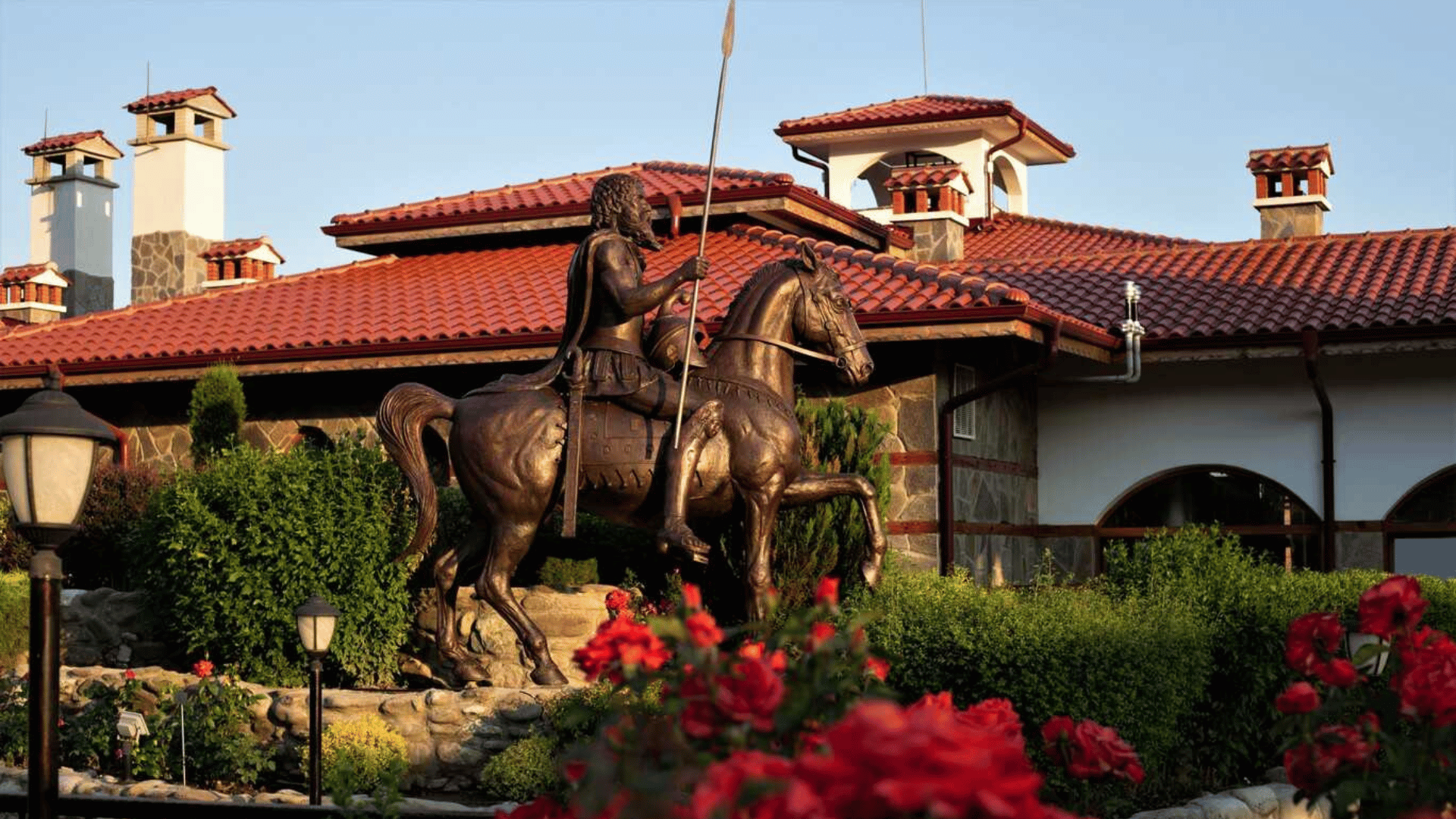
The statues of King Seutus III and his wife Queen Berenice
Gallery
Video conversation
coming soon
We are in the Valley of the Roses and the Thracian Kings
At the entrance to the Damascena Ethnographic Complex, the majestic statue of the last great ruler of the Odris kingdom welcomes you royally, king Seutus III (330 BC. to 300 BC).
During archaeological excavations at the Golyama Kosmatka mound, on 21 September 2004, Dr. Georgi Kitov discovered an exquisite, perfectly crafted bronze head, which represents a man in his prime. The face, with characteristic, nose arched in profile and prominent cheekbones, exudes dignity, strength, character and power. The head has an impeccable beard and curls - the experts are categorical, that this is King Sevtus III – the greatest Thracian ruler. Supposed, that the head was already torn off from a human-sized sculpture, which stood in the middle of the capital of King Sevtus III - Sevtopolis.
The Odris are the first, who manage to create a large and rich state, and at the same time cities. The Odrysian kingdom was the most significant state union of the Thracian tribes, which arose in the 5th century BC. The ancient Greek historian Thucydides claimed, that in the 5th c. BC. The Kingdom of Odra is the richest country on the Balkan Peninsula. The territory of the Odris kingdom included the territories along the Danube river, to the shores of the Cherno, Sea of Marmara and Aegean.
Today, the capital of the Kingdom of Odra is completely under the waters of the Koprinka Dam. (only on 19 km from here) and is the most famous underwater object in Bulgarian archaeology. Sevtopolis is the only thoroughly studied Thracian city in our country. It is not only a unique archaeological and historical site, but we learn a lot about life from it, life of the Thracians, as well as their achievements.
Seutopolis developed rapidly as a first-rate political, economic and cultural center. The discovered amphorae, ceramic dishes, terracottas and other artefacts attest to trade and cultural contacts with the great Aegean wine and olive oil producers such as Thassos, Acanthus, Rhodes, as with Athens, Corinth and other significant policies. The high urban culture of Seutopolis completely refutes the tendentious claims of ancient Greek authors about the "barbaric" culture of the Thracians.
The city was protected by a powerful fortress system, in which there was a separate additionally fortified section (turcissus). The ruler's palace was located there, as well as a sanctuary of the Great Gods of Samothrace - the Kabiri gods.
The palace of King Sevtus III had two floors, from the facade, long 40 m and richly decorated. A spacious hall stands out among the many rooms, lavishly decorated with multicolored plaster, resembling marble. Seutopolis had a large central square (agora), on which archaeologists discovered a pedestal, on which a statue of King Seutus III was apparently placed.
Mounted on his horse, in Thracian battle armor, the statue of King Sevtus III in the Damascena Complex is a unique reminder of the greatness of the glorious Odris kingdom.
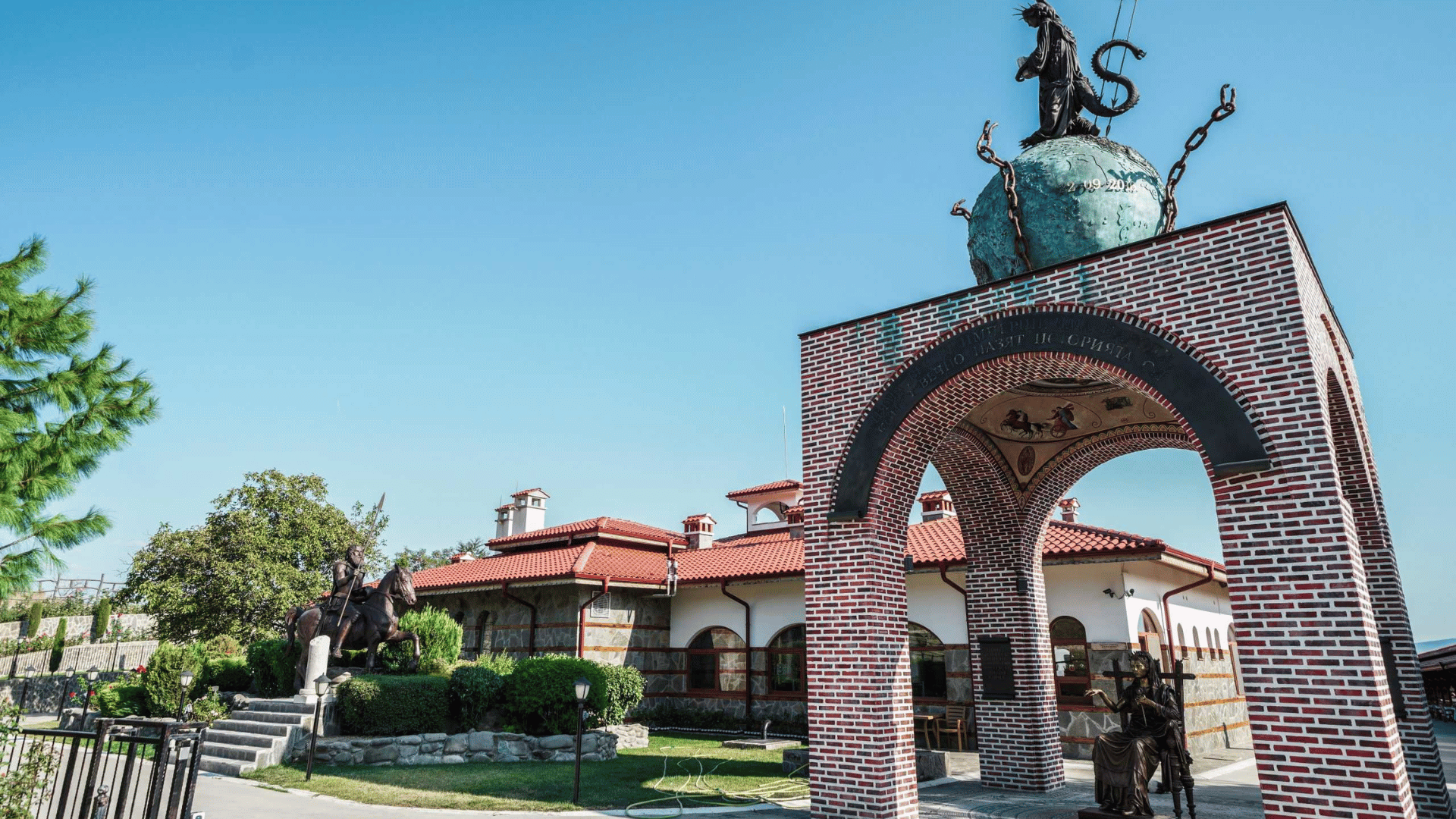
To his right, under a beautiful arch, inspired by the culture and art of the great Thracians, standing on his throne, the elegant wife of King Seutus III, Empress Berenice. Queen Berenice was the second wife of King Seutus III. She is of Asia Minor origin. After the death of King Sevt , Berenice takes power in the Kingdom of Odris.
The arch itself is interesting, because of the rich symbolism, with which each of its elements is saturated.
On the one hand, it depicts the past, consisting in the history and culture of our ancestors, firmly planted on the ground and giving us solid foundations, and on the other hand, the future of the world - above, expressing the imperial ambitions of the "Great Powers", unhealthy desire to subjugate the world. A unifying element is the inscription-message, which reminds us, that: